
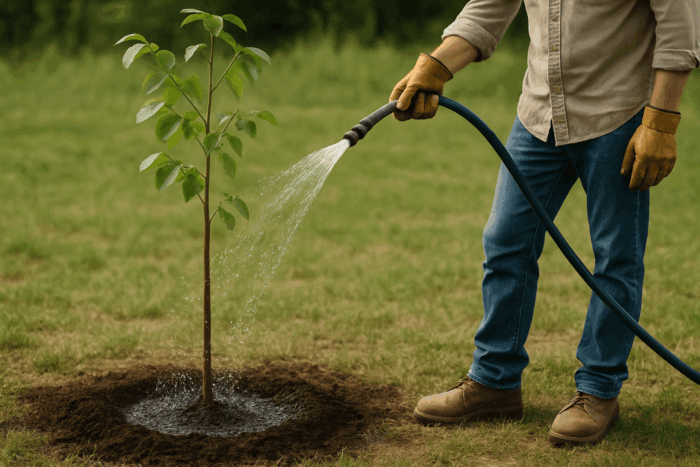
Underwatering is the #1 reason why newly planted trees die.
You planted the tree, you stood back and admired it, and now you are wondering what you are supposed to do for the next few years. The short answer is water it, and do it the right way. Lack of water is the number one reason newly planted trees die.
Why a new tree needs so much help
A tree from a nursery has only a fraction of the roots it had in the field, or it is living in a ball of soil about the size of a bucket. Until new roots grow out into your yard, that little ball is the tree’s entire water supply. Research has found that a root ball can dry out about every four to five days during summer. A mature oak can reach down and sip from a huge area. Your new maple cannot.
Homeowners should expect to water for two to three years, and longer for big transplants and evergreens. Most people stop after a few weeks. The trees that struggle are usually the ones that got a good start and then got forgotten in their second July.
First, know your soil
If you live in the Chicagoland area, you very likely have heavy clay. Clay behaves differently from the sandy or loamy soil that most watering advice assumes.
- Clay soaks up water slowly. If you blast the hose, most of it runs off down the street. Apply water slowly, and use deep, infrequent watering on clay.
- Clay holds water for a long time once it is wet. The surface can look dry while the root ball underneath is still soggy. Trees in clay may need longer gaps between waterings, and a once-a-week schedule can keep clay too wet.
- Soggy soil suffocates roots. The tiny spaces in soil hold both water and air. Fill them all with water and the roots cannot breathe. Overwatering can be as harmful as underwatering, especially in clay.
So the goal is not to water more. It is to water well, then wait and check.
Your yard may not be pure clay, though. Soil can change from one side of a house to the other, so it helps to know what you have. Here is how the three common types compare.
| Soil | How it behaves | What it means for watering |
|---|---|---|
| Clay (common in Illinois) | Absorbs water slowly, holds it a long time, and can stay soggy. | Water slowly, leave longer gaps between waterings, and always check the soil first. |
| Loam | Holds water but also drains, so roots get both water and air. | Water when the soil is dry 1 to 2 inches down. Use the weather guide below. |
| Sandy | Water drains through fast and the soil dries out quickly. | Check more often and water in shorter, more frequent sessions. It is hard to overwater, but easy to waste water by letting it run past the roots. |
Not sure which you have? Dig a hole where the tree will go, fill it with water, and see how long it takes to drain. Water that sits for a long time points to clay. Water that disappears almost right away points to sand.
Watering follows the weather, not the calendar
Soak the tree slowly and deeply on planting day. After that, there is no set schedule to follow. How often you water depends on rain, heat, wind and your soil. Check often in the first weeks, because the roots have not started to spread yet, and let what the weather has been doing decide whether the hose comes out.
| What the weather has been doing | What to do |
|---|---|
| A good soaking rain, around an inch, in the past week | Skip the hose. Check the soil before you water again. |
| Only a light shower | Check the soil anyway. A sprinkle often does not get through the mulch to the root ball. |
| Warm and dry, no real rain for a week | Check the soil and expect to water. The goal is about 1 inch of water a week, rain included. |
| Heat wave or strong wind | Check more often. In summer a root ball can dry out in four to five days. |
| Cool and cloudy | The soil stays damp longer. Check less often. |
| Heavy rain, or soil that is still wet and sticky | Hold off. Clay can stay wet for a good while. |
The one rule that holds in every row is to check the soil first. Watering on a set schedule is not efficient or reliable, and a tree does not know what day it is.
How to check the soil
Push the mulch aside and dig down 1 to 2 inches with your fingers. If the soil is damp, leave it alone. If it is dry, water. Another option is a long screwdriver or a piece of rebar pushed into the soil near the root ball. Very dry soil fights back. If it slides in easily and comes out wet and sticky, you are fine.
Check the root ball and the soil just outside it. In clay, the ball and the surrounding ground can hold different amounts of water, so one can be dry while the other is wet.
How to water
Go slow. Set the hose to a slow trickle at the base and let it soak in. Let the water pool and sink in a few times rather than flooding it once. A slow-release watering bag, the kind you wrap around the trunk and fill up, works well for the first year and is nearly foolproof in clay, since it feeds water out over hours.
How much. The general rule is that a new tree needs the equivalent of 1 inch of rain a week, which comes to roughly 5 to 10 gallons for a small tree. That includes rain, so skip the hose after a good soaking. Bigger trees with bigger root balls will want more. If you use a sprinkler, set a tuna can nearby and see how long it takes to collect an inch.
Time of day. Morning is best. Less water evaporates and the leaves dry out quickly if they get wet.
Water the soil, not the leaves. Keep the hose at the base of the tree.
Mind the mulch. A few inches of mulch helps hold moisture in, but keep it pulled back from the trunk. If you use shredded mulch, it can form a crust that sheds water. Break it up so the water gets through.
Where to put the water
A new tree drinks from its root ball first, so that is where the water goes in year one. As the roots grow outward, the area you water grows with them.
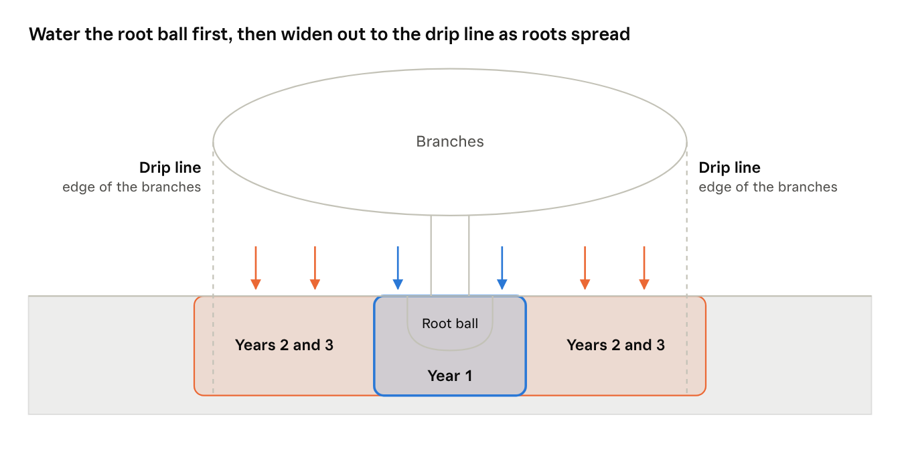
The drip line is the ground under the tips of the branches, where the roots that take in the most water tend to be. Aim for it in the second and third years, and a little past it is fine.
Signs you have the balance wrong
- Too dry: wilting, curled or scorched leaf edges, leaves dropping early in summer.
- Too wet: soil that stays soggy or smells sour, and yellowing leaves while the soil is still wet. If you suspect this, stop watering and let it dry out.
The tricky part is that some of these look alike. When in doubt, go back to the soil check before you pick up the hose.
Years two and three
The roots are spreading now, so the rules change a little.
- Check the soil during dry weather, and water only when it needs it.
- Water out to the drip line, the edge of the branches, where the roots that take up the most water are.
- Treat a dry summer like year one again. A drought can set back a young tree even in its third year.
Fall and winter
Do not put the hose away too early. Water new trees and evergreens as long as the soil is not frozen, and in fall and winter if the soil is dry. Evergreens keep losing moisture through their needles all winter, so they are the most at risk.
When is a tree established?
There is no single date. Most trees need two to three growing seasons, and some need longer. A good sign is steady growth and healthy leaves through a dry summer without much help from you. When you get there, you can ease off, though a long drought still calls for a deep soaking.