
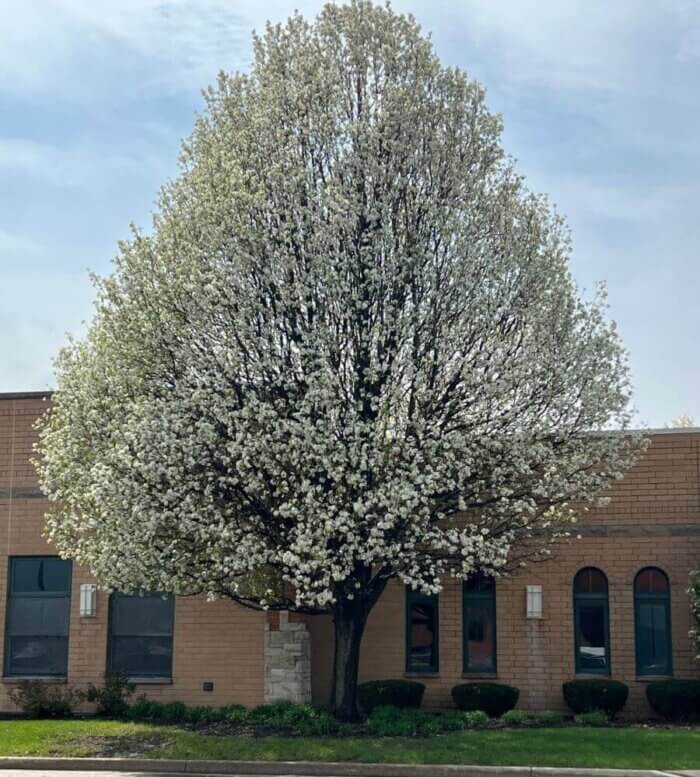
Don’t Plant Bradford Pear Trees
The Bradford/Cleveland Select/Callery pear is a popular ornamental tree in the U.S., especially in the Midwest and South.
Why It’s An Epidemic
It has become invasive. Although originally bred to be sterile, Bradford pears cross pollinate with other pear trees, producing viable seeds. Birds eat the fruit and spread the seeds, which grow into wild, thorny thickets. These wild pear trees outcompete native plants and form dense monocultures, especially in disturbed areas, roadsides, and open fields.
It has weak branch structure. The tight branch angles of Bradford pears make them prone to splitting, especially in storms or under snow/ice loads. This leads to early failure; many trees start falling apart after just 15–20 years.
It chokes out native species. It shades out native wildflowers and tree seedlings. The invasive offspring have sharp thorns, making them hard to remove and dangerous for wildlife and people.
It has smelly flowers. The spring blossoms are beautiful but have an unpleasant, fishy or rotting smell.
It is costly to manage. Cities and homeowners are spending millions removing and replacing them. Bradford pears have dense wild growth and they are expensive and labor intensive to clear. Although some cities in Illinois have banned the sale of Bradford pears, Illinois currently has not listed them as invasive.
By understanding the real impact of Bradford pear trees and why they’ve become such a widespread problem, you’re already one step closer to protecting your local ecosystem. If you’re planning to remove an existing Bradford pear or avoid planting one in the future, take the time to choose a healthy, site appropriate native tree instead.
Better Alternatives Include:
Serviceberry (Amelanchier spp.)
Eastern redbud (Cercis canadensis)
Flowering dogwood (Cornus florida)
Fringetree (Chionanthus virginicus)
Crabapple (select disease-resistant varieties)