
Why Is My Tree Yellow In Summer? How To Treat Iron Chlorosis
Chlorosis is a condition where green leaves turn yellow because of insufficient chlorophyll production. In Illinois, common causes of chlorosis in trees include nutrient imbalances linked to alkaline (high pH) soils, drought stress, poor soil drainage, and compacted soil. Trees frequently affected include red maple, white oak, pin oak, bald cypress, magnolia, white pine and river birch.
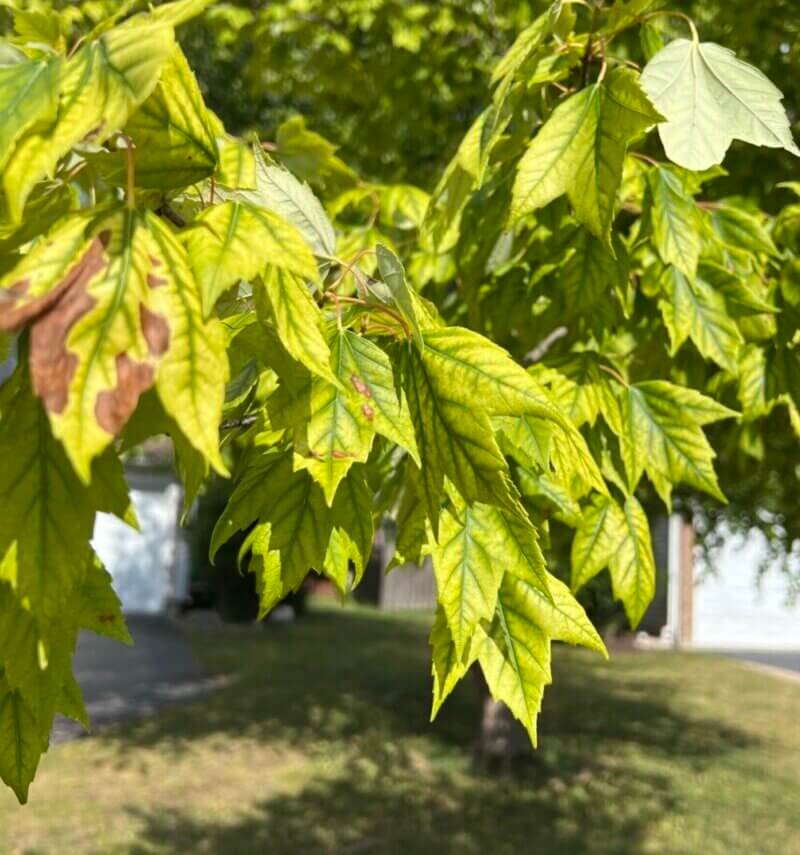
The earliest sign is fading of the leaf’s green color, which sometimes progresses to a general yellowing. In mild cases, leaves may look light green while the veins stay distinctly green. As the condition worsens, the tissue between the veins becomes bright yellow. Margins may scorch or develop brown, angular spots, and affected leaves often wither and fall off early. In coniferous trees, needles turn yellow across the whole plant; if the condition becomes serious, the needles brown and fall off, and twigs or entire branches may begin to die back.
Avoid planting tree species that are prone to chlorosis in soils with high pH levels. Trees not susceptible include serviceberry, crabapple, linden, redbud, katsura, and ginkgo. If chlorosis symptoms appear, it’s important to identify the root cause before taking action. Conducting a soil test can help determine nutrient levels and pH, allowing for a targeted approach to treatment. Once the issue is diagnosed, take appropriate corrective steps to protect the plant and prevent further decline.
Short Term Treatments
Most treatments only relieve symptoms and not the root cause. Soil fertilization is the most effective long term solution, though it works slowly. For mild cases, use a nitrogen-sulfur fertilizer to add slight acidity. Apply in early spring to mid May.
Options:
- Mix chelated iron into the top 2 inches of soil; water well.
- Apply manganese or iron sulfate (0.25 lb per 100 sq. ft.) and water in.
Foliar sprays green up leaves faster but only last 60–90 days and don’t affect new growth. Spray in late spring or early summer as leaves expand. Reapply as needed. Trunk injections (done by pros) are fast acting and last 2–3 years, but are best left to certified arborists.
Long Term Treatments
Improving the tree’s root environment gives the best long-term results.
Steps:
- Remove grass from under the tree.
- Add 1–2 inches of compost, then 3–4 inches of mulch. This helps retain moisture, protect roots from temperature swings, and reduce competition.
- Water during dry spells to reduce stress.
- Avoid fertilizers with potassium, phosphorus, nitrates, or lime unless a soil test shows a need.
Sulfur Application (to lower soil pH): Always water in thoroughly to avoid turf damage. In early spring or fall, apply 3 lbs of granular sulfur per 100 sq. ft. under the tree canopy (out to the drip line). Optionally, apply 1.5 lbs beyond the drip line. You can also split the treatment: half in fall, half in spring.
Another long term solution for chlorosis is the technique outlined by Whitcomb, Carl E. Total Nutrition for Trees and A Technique for Solving Chlorosis Problems, in which two inch holes are drilled and filled with Micromax®, granular elemental sulfur, and Osmocote®. This technique has been used by the Witness Tree staff and is our preferred method. In our hands it has been effective 10+ years.